Common Raised Bed Sizes and Soil Volumes
Compare how bed length, width and depth change total soil volume; doubling bed area doubles fill at the same depth.

Compare how bed length, width and depth change total soil volume; doubling bed area doubles fill at the same depth.
Estimate planting positions with 4×8 raised bed plant calculator using bed dimensions and crop spacing without forcing wide-spaced crops into one plant per square foot.
4×8 Raised Bed Grid: sketch planting positions in a 4×8 bed and mark trellises, paths or succession zones. Use this PDF as a paper reference or record sheet.
Estimate planting positions with 4×4 raised bed plant calculator using bed dimensions and crop spacing without forcing wide-spaced crops into one plant per square foot.
A 4×4 bed is easier to reach around and needs half the soil volume of the same-depth 4×8 bed; a 4×8 bed gives twice the growing area per frame end.
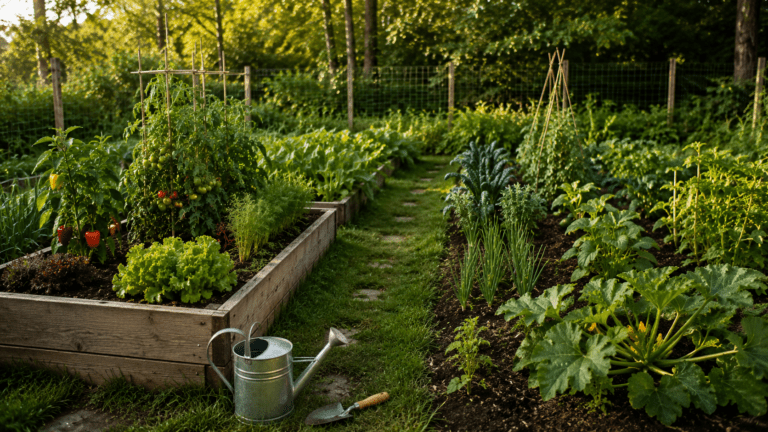
Raised beds give more control over imported soil and access; in-ground beds use existing soil and avoid the cost/volume of bed fill.
Raised Bed Planning Sheet: record bed dimensions, crop choices, support and soil notes before planting. Use this PDF as a paper reference or record sheet.
Turn bed length, width, sun and crop choices into a first-pass raised-bed layout.

At about 24-inch spacing, a simplified 4×8 grid fits about 8 tomato planting positions; row systems and crop habit may call for fewer.
At about 12-inch spacing, a simplified 4×8 grid fits about 32 cucumber planting positions; row systems and crop habit may call for fewer.
Estimate planting positions with plants per raised bed calculator using bed dimensions and crop spacing without forcing wide-spaced crops into one plant per square foot.